You know the morning light in the kitchen. You like the neighbours. You have no desire to leave the street.
But the house itself has become a compromise.
Deciding whether to renovate or rebuild in West Vancouver begins with separating what you value about the property from what still works about the building. A beautiful setting is worth keeping. It does not, by itself, answer how much of the house should remain.
Is renovation or rebuilding the better choice?
Renovation deserves serious consideration when the existing structure and layout can support your priorities with a clear, manageable scope. Rebuilding deserves comparison when achieving those priorities would require extensive changes across the structure, enclosure, services and arrangement of the home.
Neither option is automatically cheaper or faster. Compare two defined approaches to the same brief.
Write the brief before discussing demolition
Describe the problems in everyday language:
- The kitchen feels disconnected from the garden.
- Bedrooms are in the wrong places for our family.
- We need fewer stairs between essential rooms.
- Storage has never worked.
- We want a quieter, more comfortable home.
Then rank them. Decide which outcomes are essential and which are preferences.
This makes the comparison fair. A modest renovation should not be presented as equivalent to a replacement house that solves every item on the list.
Establish what the existing house can contribute
Arrange a condition and feasibility review appropriate to the work you are considering. The structure, moisture history, roof, windows and mechanical systems may need different specialists.
Ask for three categories: items suitable to retain, items requiring work, and items whose condition remains uncertain.
For example, retaining a wall may appear economical until the proposed layout requires changes to its openings, structure, wiring and finishes. Equally, a sound, well-positioned part of the house may be worth preserving rather than replacing simply for consistency.
The decision should follow the investigation.
A renovation that kept the house: The Zen on Bramwell
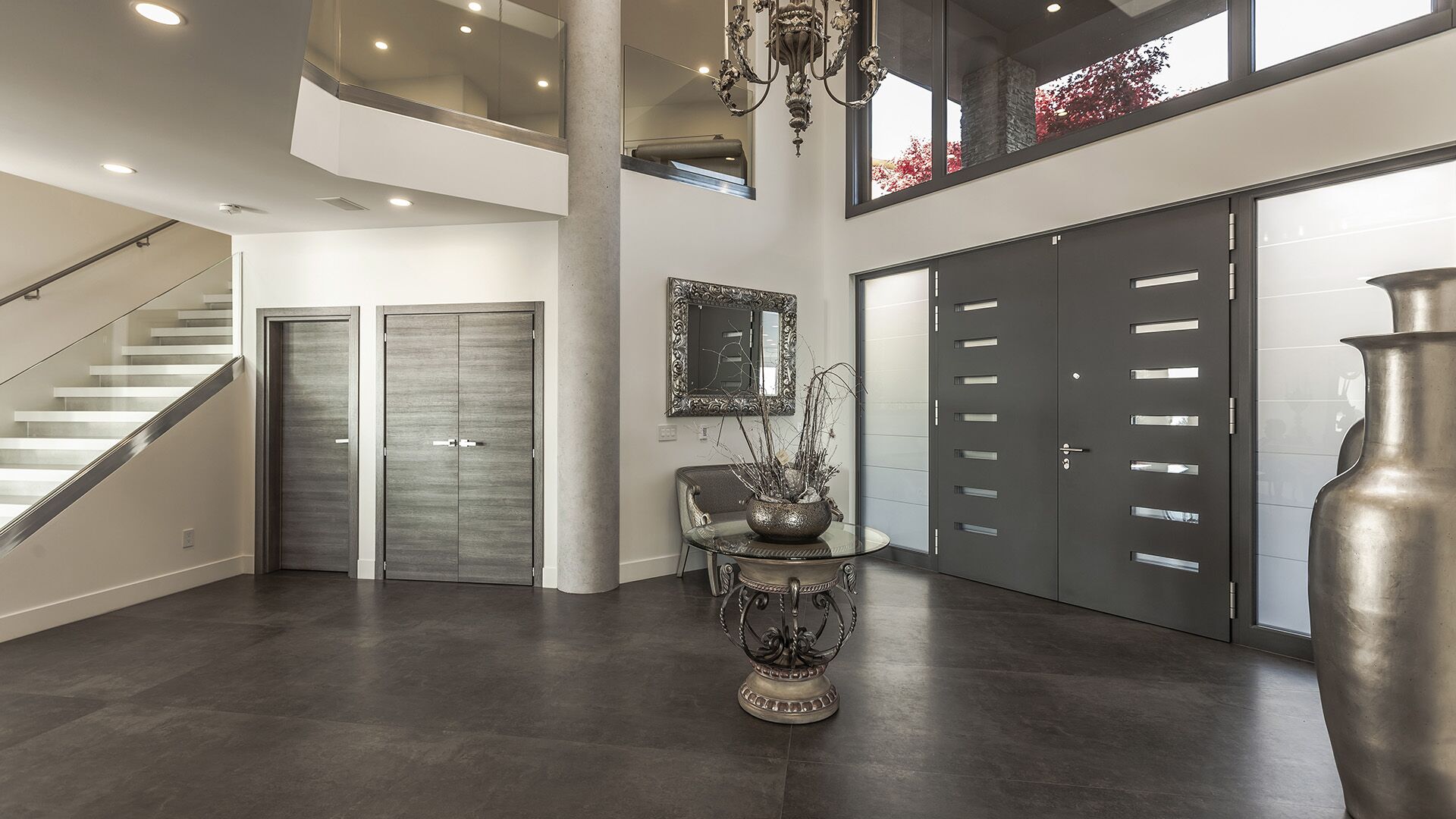
The Zen on Bramwell is a substantial two-floor renovation of a 30-year-old home in the British Properties. Rather than replacing the house, the work combined new interiors with building envelope remediation and replacement of the exterior hard surfaces. The homeowners lived on site throughout.
It shows that a deep renovation can reach the building's structure and enclosure, not only its finishes, and that staying in the home during the work can be possible.
Compare the two scopes side by side
| Decision | Renovation question | Rebuild question |
|---|---|---|
| Layout | Which compromises remain? | Can the new arrangement deliver the priorities? |
| Existing fabric | What is genuinely reusable? | What demolition and replacement work is needed? |
| Site | What work is still necessary? | What does the new footprint require? |
| Comfort | Which upgrades fit the retained construction? | How will performance be designed and verified? |
| Disruption | Can any space remain occupied safely and practically? | What accommodation period needs planning? |
| Budget | Which concealed conditions remain uncertain? | Which site and specification assumptions remain unresolved? |
Use the same finish expectations and external works in both budgets. Otherwise, the comparison measures different projects.
Check what you can lawfully retain before discussing demolition
The house you can see, the house shown in approved records and the house you could build today may be different.
Ask the team to establish the approved existing building, its condition and the scope of alterations being proposed. An older position close to a boundary may deserve investigation before demolition, but it does not establish a right to reproduce that footprint.
Section 529 of BC’s Local Government Act addresses certain structures whose use and density conform but whose siting, size or dimensions do not. Its alteration provisions have conditions, including no further contravention and applicable heritage requirements. Other non-conformities can follow different rules.
Obtain advice on the specific property and written municipal clarification of the proposed scope where needed. Do not base the project on a neighbour’s experience or a promise that “keeping one wall” settles its status.
Check heritage status, and whether a third option exists
An older home is not automatically a protected heritage property. Equally, “not designated” is not a complete planning review.
West Vancouver distinguishes Community Heritage Register recognition from heritage designation and conservation-area controls. Register listing alone does not prohibit alterations that comply with applicable laws; designation, an existing agreement or a conservation-area location can change the approval route.
For a suitable heritage property, ask whether conservation-led renovation with an addition or infill merits investigation. A Heritage Revitalization Agreement is negotiated with the municipality; potential incentives are not automatic development rights.
If additional homes are part of the brief, compare that route separately. Establish the current rules for the address before attaching value to extra dwellings. West Vancouver's proposed Bylaw 5446 would change what many single-family lots allow; confirm its current status, and see Bylaw 5446 explained for the detail.
Avoid the halfway project nobody intended
A renovation can expand through individually reasonable decisions: replace the roof while it is accessible, move another wall, upgrade a service, then change a window group.
Before authorizing those additions, revisit the whole brief. Ask whether the revised renovation still offers a coherent advantage over the alternatives.
Conversely, a rebuild should not accumulate features simply because the site has become a blank canvas. Keep the original priorities and budget visible.
Frequently asked questions
Is there a percentage at which renovation stops making sense?
There is no universal threshold that resolves the decision. Compare the finished result, retained value, uncertainty, total cost and disruption of the specific options.
Can we live in the house during a major renovation?
Sometimes. The owners of The Zen on Bramwell stayed in their home through a two-floor renovation. Whether it works for you depends on the work, safe access, services and separation from construction. Assess it before assuming that accommodation costs can be excluded.
Who can help us compare both routes?
A team that understands both major renovation and new-home construction can evaluate the alternatives with the same brief. Eurohouse provides West Vancouver home renovations and custom homes.
Get a second perspective before committing to one route
Bring the address, available plans, photographs and the changes that would make the biggest difference to your life.
Book a free initial renovate-or-rebuild review. We will discuss the options and the investigations that can make the decision clearer.
Call 604-728-5682 or email info@eurohouse.ca.