
Rain doesn't stop a pour, bad timing does
On the North Shore it rains. If we cancelled every pour with rain in the forecast, half our concrete would never get placed between October and May. The real question is never "is it raining?" It's "where is the water going, and what is this surface going to become?"
The damage rain does to concrete is almost entirely about the surface. When raindrops land on fresh, plastic concrete, they add water to the top layer and raise the surface water-to-cement ratio. That extra water weakens the very top skin of the slab, and the result can be scaling, dusting, and soft spots once it cures. Ponding water is worse: it dissolves and washes away the cement paste that should be binding the surface together. Fresh concrete generally needs roughly four to eight hours before rain can no longer mark it, and the first couple of hours are the most vulnerable.
So the answer isn't "never pour in the rain." It's "control the water at the surface, and know whether that surface even matters."
The key distinction: covered slabs vs. finished surfaces
This is the single most important judgment call, and it's why two pours on the same rainy morning can get completely different decisions.
Slab-on-grade that gets covered ✓
- Sits inside a framed and roofed structure, mostly sheltered already
- Final floor (tile, hardwood, topping, equipment pads) hides minor surface marks
- A few drips off boots or framing are cosmetic, not structural
- Often poured over radiant tubing and rebar, then covered, protection is built in
Exposed finished surface ✗
- Patios, driveways, walkways, broom-finished flatwork, the surface is the product
- Rain marks, scaling, and dusting are permanent and visible
- No second finish to hide damage
- Exposed to freeze-thaw later, so a weak surface fails faster
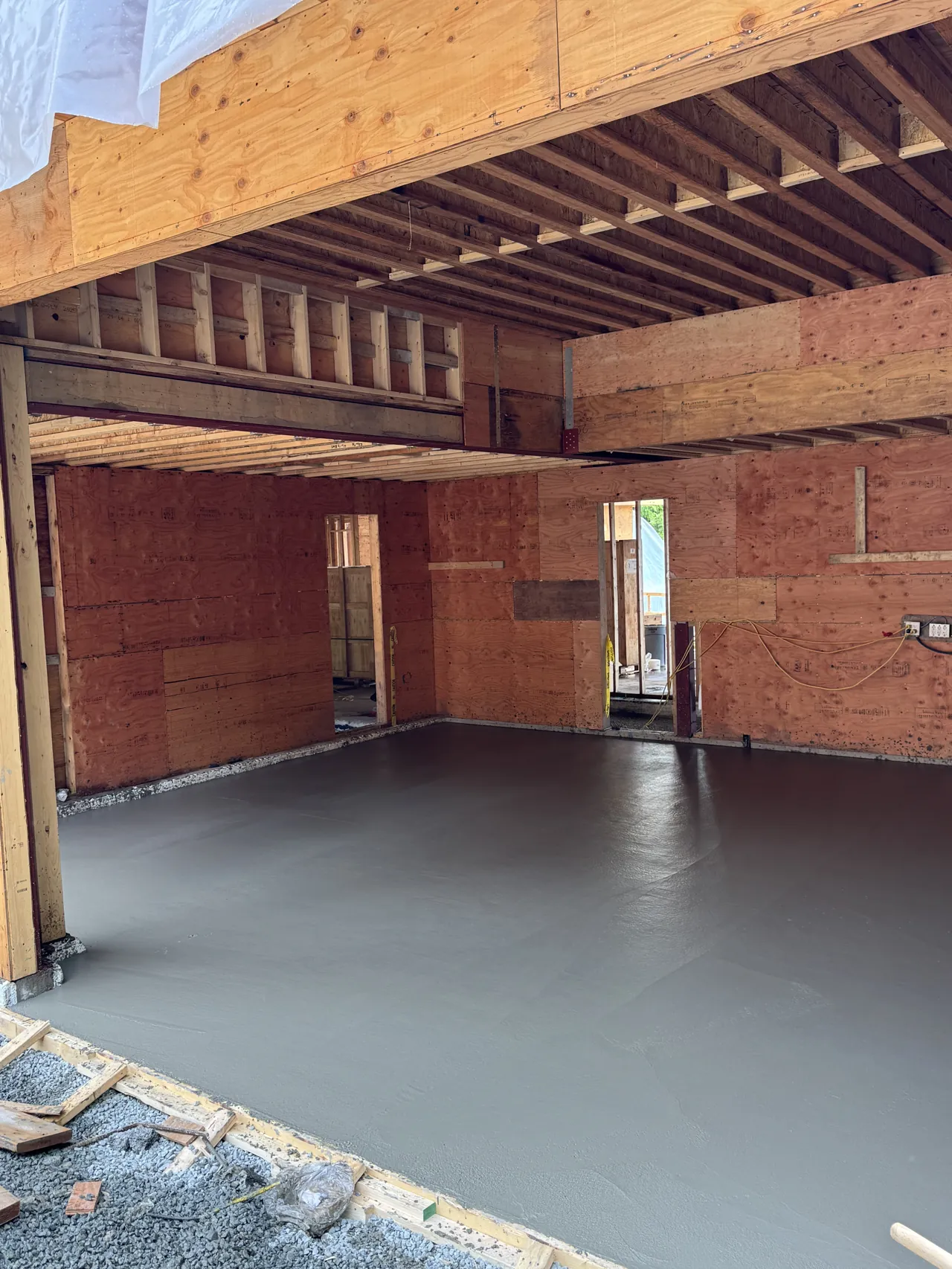
A slab-on-grade for a new home is the forgiving case. It's poured inside the framing, usually under a roof or deck above, and it disappears under the finished floor. A little rain drifting in, or a few drips off the crew, won't change anything you'll ever see. That's why we're comfortable placing interior slabs on days we'd never pour an exterior patio.
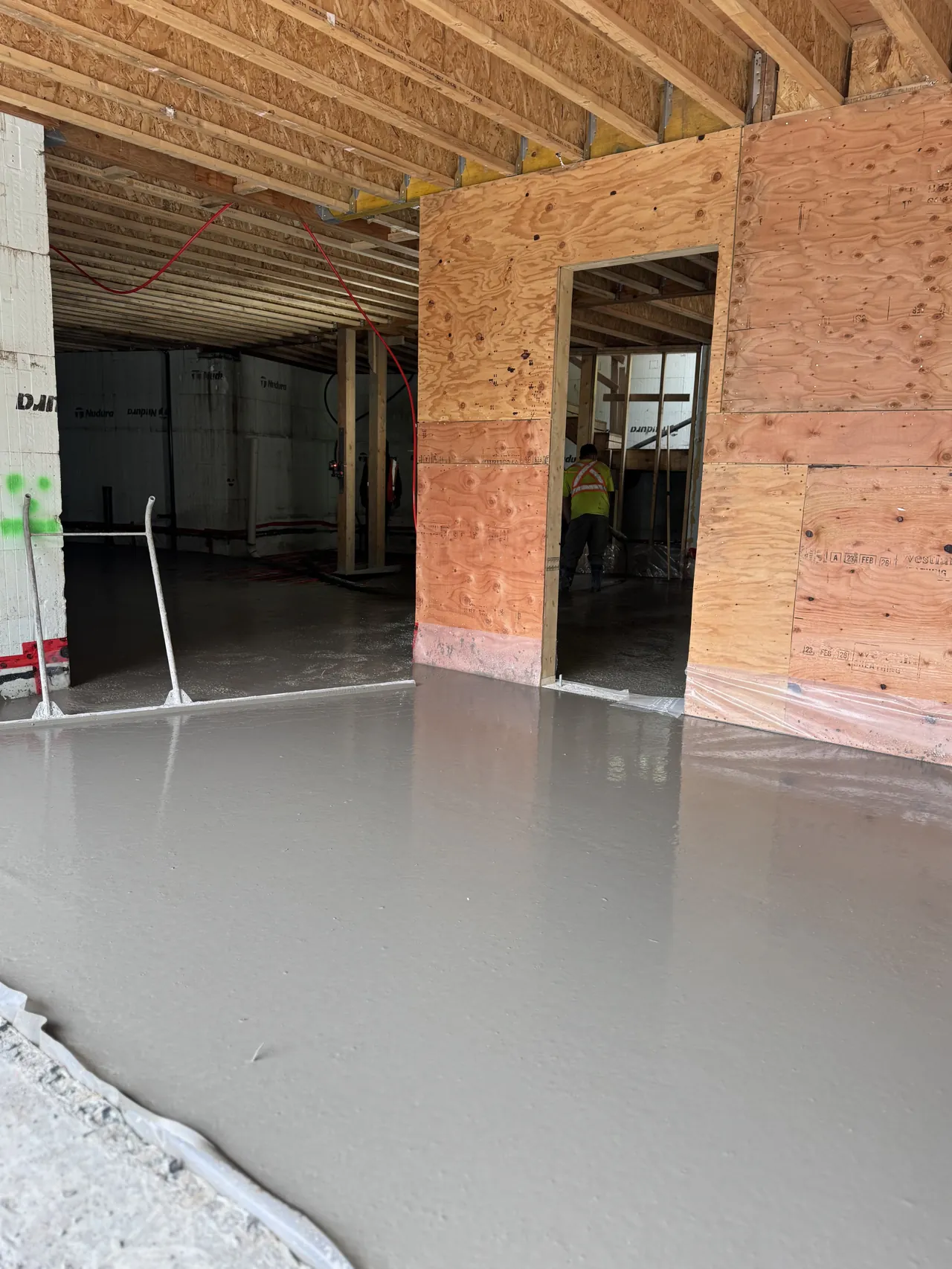
A patio is the opposite. The troweled or broom-finished surface is the final product, so every rain dimple and every patch of surface dusting stays visible for the life of the slab. For exterior finished flatwork we hold off, tent the area, or shift the schedule when meaningful rain is coming.
Will this surface be covered? If yes, light rain is a manageable nuisance. If the surface is the finished product, rain is a defect, so we protect it or we wait.
Pouring through the rain: pros and cons
There are real reasons to pour on a wet day, and real reasons to wait. Both are legitimate, the trade-off depends on the element and the schedule.
The case for pouring
- Schedule reality. On the coast, waiting for a dry stretch can cost weeks. Foundations and covered slabs keep the whole project moving.
- Curing likes moisture. Concrete cures by hydration, not by drying. Cool, damp, overcast conditions are actually kind to a curing slab: they slow evaporation and reduce cracking risk.
- Covered work is protected. Foundation walls and interior slabs are sheltered by formwork or the building itself.
The case for waiting
- Finished surfaces get marked. Exposed flatwork can scale or dust if rain hits before it sets.
- Finishing gets harder. Crews can't trowel a surface that water keeps sitting on, and you must never work surface rainwater back into the slab.
- Subgrade and access. Heavy rain can soften the subgrade under a slab or turn a steep North Shore site into a mud problem for the trucks and pump.

Temperature matters as much as rain
Water is only one variable. On the coast we mostly fight rain; up in Whistler and on the higher North Shore slopes, cold is the bigger enemy.
Cold weather
Under the Canadian concrete standard (CSA A23.1), once the air is at or below 5°C (or likely to drop there within 24 hours), cold-weather concreting rules kick in. The reason is simple and unforgiving: concrete that freezes in its first 24 hours, before it reaches roughly 7.0 MPa, can lose more than half of its strength permanently. There's no fixing it after the fact. The standard calls for keeping the concrete near 10°C for about seven days while it gains strength. To hit that in a Whistler winter we use heated mixing water, set accelerators, insulated blankets over the slab, and full hoarding with heaters when needed.
Hot weather and direct sun
The opposite problem is just as real on a clear summer day. Direct sun, heat, low humidity, and wind pull moisture out of the surface faster than the concrete can supply it. That causes plastic shrinkage cracking (those random surface cracks that open while the concrete is still soft), and a flash set that gives the crew almost no working time to finish. On hot days we pour early in the morning, add water reducers and retarders to buy finishing time, dampen subgrades and forms, use evaporation retardant on the surface, and start curing the moment the surface can take it.
Rain adds water at the surface, cold robs early strength, and sun rips moisture out too fast. Good concrete work is just controlling all three long enough for the slab to gain strength on its own terms.
How we pour year-round: additives and blankets
Most weather problems are solved before the truck arrives, in the mix design and the protection plan.
- Accelerators speed up early set and strength gain in the cold so the slab gets past the freezing-vulnerable window faster.
- Water reducers and superplasticizers keep the mix workable without adding water, which protects strength in any weather.
- Set retarders slow things down on hot days so the crew has time to place and finish properly.
- Air-entrainment tiny air bubbles that let exterior concrete survive our freeze-thaw cycles; standard on any flatwork that lives outside.
- Heated water and aggregates raise the starting temperature of the mix on cold mornings.
- Insulated and curing blankets trap the heat the concrete generates as it cures, holding it warm overnight; in deep cold we tent the area (hoarding) and add heat.
- Tenting and sheeting for exposed surfaces, a temporary cover keeps rain off until the surface has set hard enough to shrug it off.
Local context: West Vancouver, the North Shore, and Whistler
The same pour gets a different plan depending on where it is. In West Vancouver and across the North Shore, rain and steep, tight sites are the daily challenge, our planning is about water management, subgrade protection, and getting trucks and pumps onto difficult lots. In Whistler, cold and frost dominate, so the mix, blankets, and hoarding do the heavy lifting. Either way, the goal is the same: place sound concrete on the schedule the project needs, not the schedule the weather would prefer.
If you're planning a foundation, a slab, or exterior flatwork and you're wondering whether the season is working against you, that's exactly the kind of call we make every week as a West Vancouver general contractor whether it's a custom home or a major renovation. Get in touch and we'll walk you through the right approach for your site.
Frequently asked
Can you pour concrete in the rain?
Yes, with the right precautions. A slab-on-grade that will be covered by flooring or structure tolerates light rain, because minor surface marks are hidden once the final finish goes on. Exposed, finished surfaces like patios and driveways are far less forgiving and are usually rescheduled or tented if heavy rain is forecast.
Why is rain a problem for fresh concrete?
Rain landing on plastic concrete adds water to the surface and raises the surface water-to-cement ratio. That weakens the top layer and can cause scaling, dusting, and soft spots. Concrete generally needs four to eight hours before rain can no longer harm the surface.
What temperature is too cold to pour concrete?
Under CSA A23.1, when the air is at or below 5°C, cold-weather measures are required. Fresh concrete that freezes in the first 24 hours, before it reaches about 7.0 MPa, can lose more than half its strength permanently. We use heated mixes, accelerators, insulated blankets, and hoarding to hold the concrete near 10°C while it cures.
Does direct sun or heat hurt a concrete pour?
Yes. Hot, dry, sunny, or windy conditions pull moisture out of the surface too fast, causing plastic shrinkage cracking and a flash set that makes finishing difficult. We schedule early, use retarders and evaporation retardant, and cure aggressively to control it.
Is it okay to pour a slab-on-grade if it might rain?
Often yes. A slab-on-grade inside a framed and roofed structure is sheltered from most rain, and because it will be covered by the finished floor, minor drips are cosmetic rather than structural. The judgment call is about the volume and timing of water, not whether a few drops fall.