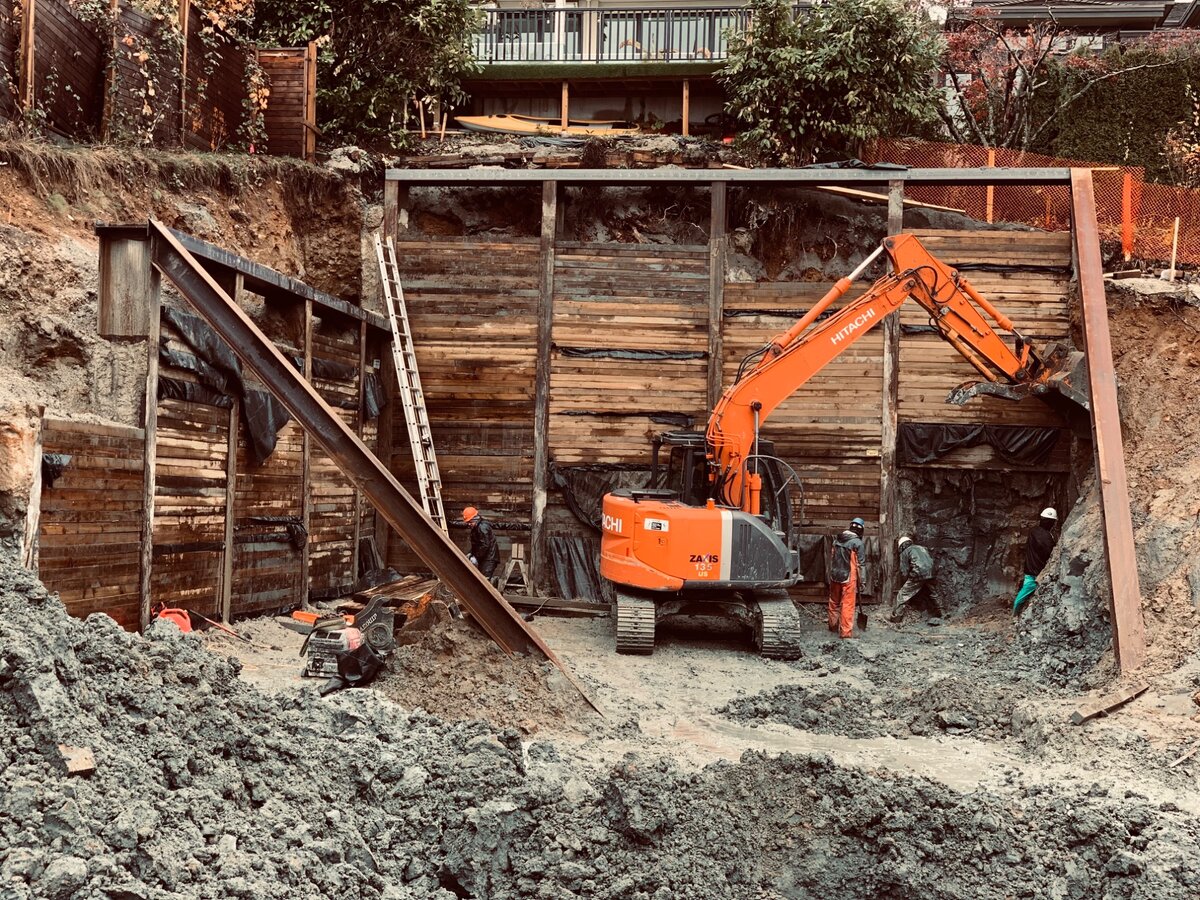
When excavating deep foundations in West Vancouver's challenging clay soil conditions, pile driving becomes essential for protecting neighbouring structures. Clay soil presents unique geotechnical challenges that require careful engineering and execution, its plasticity causes lateral movement under load, and saturated clay can lose bearing capacity when disturbed during excavation.
At Eurohouse Construction, we regularly encounter these conditions in hillside residential projects across West Vancouver, North Vancouver, and the Lower Mainland. Our approach involves installing soldier piles and lagging systems to create temporary shoring walls that transfer loads safely to stable soil strata below the excavation zone.
Understanding Clay Soil Challenges in Coastal BC
The Lower Mainland's geological history has left behind complex soil conditions that vary significantly across relatively short distances. Marine clay deposits, glacial till, and variable bedrock depths create unpredictable conditions that demand thorough geotechnical investigation before any deep excavation work begins.
Clay soil behaves differently than granular soils like sand or gravel. When you remove lateral support during excavation, clay doesn't simply stay in place: it can flow, heave, or settle depending on moisture content and loading conditions. This behavior poses significant risks to adjacent structures, underground utilities, and landscaping.
Key Characteristics of Problematic Clay Soils
- Plasticity: Clay particles can slide past each other when wet, causing soil mass movement
- Sensitivity: Disturbed clay can lose significant bearing capacity compared to its undisturbed state
- Consolidation: Clay compresses slowly under load, leading to long-term settlement
- Perched water tables: Clay layers can trap groundwater, creating unexpected hydrostatic pressure
- Shrink-swell behavior: Seasonal moisture changes cause volume changes that can damage foundations
Soldier Pile and Lagging Systems: How They Work
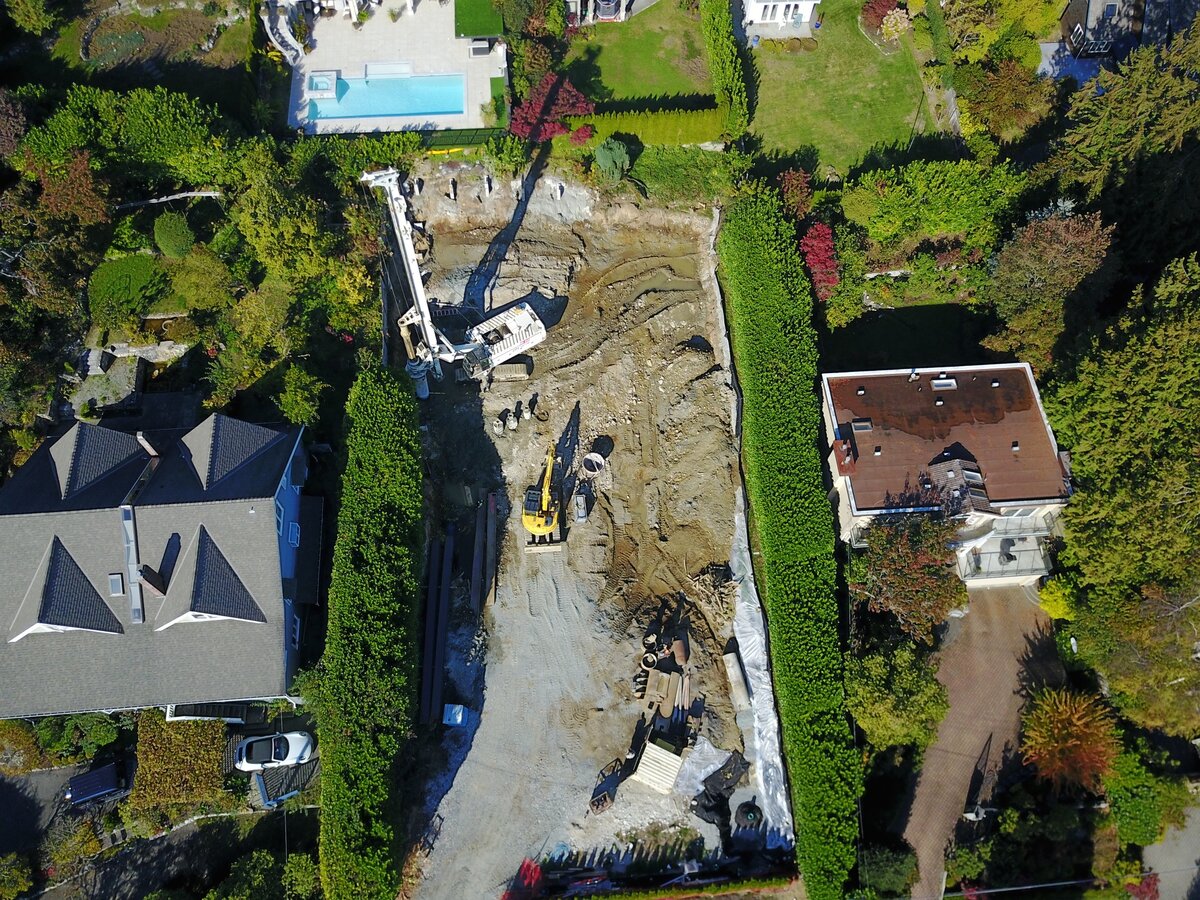
The soldier pile and lagging system is the most common temporary shoring method for residential deep excavations in our region. Steel H-piles are driven or drilled into the ground at regular intervals, typically 1.8 to 3 meters apart, before excavation begins. As excavation progresses, horizontal timber or concrete lagging is installed between the piles to retain the soil.
The system works by transferring lateral earth pressure from the soil behind the wall to the vertical piles, which are anchored in stable soil or bedrock below the excavation depth. In challenging conditions, we may also install tiebacks, steel tendons drilled into the soil at an angle and anchored beyond the failure plane, to provide additional lateral support.
Critical Design Considerations
- Pile embedment depth: Piles must extend far enough below excavation level to develop adequate passive resistance
- Pile spacing: Closer spacing for deeper excavations or softer soils
- Lagging installation timing: Must be installed promptly as excavation proceeds to prevent soil loss
- Drainage: Water management behind the wall prevents hydrostatic pressure buildup
- Monitoring: Survey points track any movement of the shoring system or adjacent structures
Protecting Neighbouring Structures
The primary purpose of shoring is to protect adjacent properties from damage during construction. In dense residential neighbourhoods like those throughout West Vancouver, neighbouring homes may be just meters away from the excavation. Without proper shoring, these structures risk:
- Foundation settlement or rotation
- Cracking in walls, floors, and ceilings
- Damage to underground utilities (water, sewer, gas, electrical)
- Landscaping damage from soil movement
- In extreme cases, structural failure
We work closely with geotechnical engineers to design shoring systems that provide adequate protection with appropriate safety factors. Pre-construction surveys document the condition of neighbouring properties, and we maintain open communication with neighbours throughout the excavation process.
Key Takeaways for Property Owners
- Always obtain a geotechnical report before planning deep excavation
- Budget for engineered shoring, it's not optional in clay soil conditions
- Expect monitoring requirements throughout the excavation phase
- Communicate with neighbours early in the planning process
- Work with contractors experienced in challenging soil conditions
Our Approach at Eurohouse Construction
With 16+ years of experience in West Vancouver's challenging building environment, we've developed systematic approaches to deep excavation that prioritize safety and neighbour relations. Every project begins with comprehensive geotechnical investigation and ends with documented monitoring records.
Our team coordinates closely with structural engineers, geotechnical consultants, and shoring contractors to ensure seamless execution. We maintain WorkSafeBC compliance throughout all excavation operations and carry comprehensive liability coverage that protects both our clients and their neighbours.
If you're planning a residential project that requires deep excavation, we'd welcome the opportunity to discuss your site conditions and develop an appropriate construction approach. Contact us to schedule a consultation.