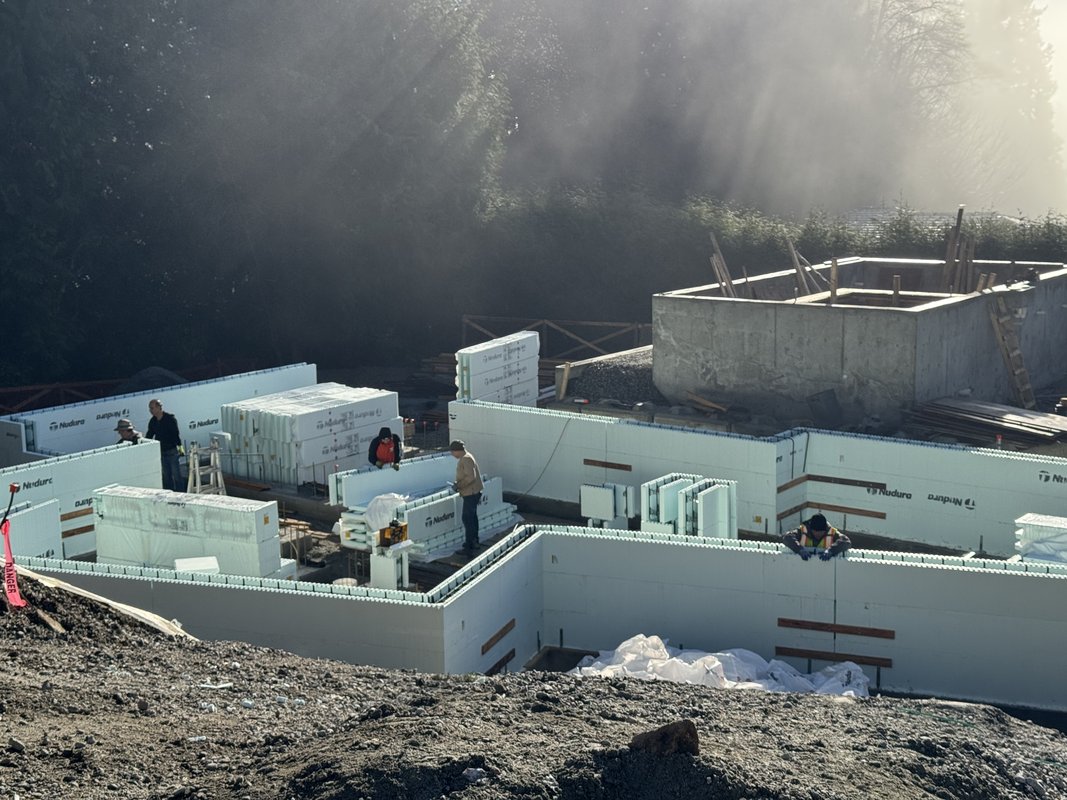
Modern high-performance homes increasingly rely on ICF (Insulated Concrete Form) foundations for structural strength, energy efficiency, and longevity.
But ICF changes one critical detail:
⚠️ You cannot use solvent-based waterproofing products on ICF. EPS foam insulation is permanently bonded to the concrete core. Acetone or solvent primers will degrade the foam and compromise structural integrity. Any waterproofing system used on ICF must be water-based and foam-safe.
In residential construction today, two professional-grade dampproofing approaches dominate:
- Liquid-applied elastomeric waterproofing + dimple drainage membrane
- Self-adhered peel-and-stick sheet membranes
Both are viable. The difference lies in constructability, cost efficiency, and risk management.
Option 1: Liquid-Applied Waterproofing + Dimple Drainage Membrane
This system combines spray-applied elastomeric waterproof coating with a protective HDPE dimple membrane that creates a vertical drainage plane.
Typical workflow:
- Patch tie holes and surface imperfections
- Spray liquid waterproofing (40 mil or 60 mil thickness)
- Install dimple board membrane
- Backfill after curing
Why Builders Prefer This System on ICF:
- Foam-safe chemistry Water-based, VOC compliant, solvent-free, specifically approved for ICF applications
- Thickness flexibility 40 mil standard or 60 mil enhanced for high water tables
- Integrated drainage + protection Dimple membrane creates continuous air gap and vertical drainage path
- Warranty stack Up to 40-year no-leak warranty with proper installation
- Speed + cost efficiency Spray application is fast, conforms to corners and penetrations
60 mil systems exceed waterproofing code requirements and provide exceptional crack-bridging capability with over 1000% elongation.
Option 2: Peel-and-Stick Sheet Membranes
Peel-and-stick systems use factory-manufactured rubberized asphalt sheets adhered directly to foundation walls. They are widely respected products and commonly specified on commercial projects.
However, on ICF foundations they introduce additional complexity:
- Surface sensitivity Walls must be perfectly clean, dry, and uniform
- Primer restrictions Only water-based primers permitted (solvents damage EPS foam)
- Labour intensity Every seam, overlap, corner, and penetration is manual
- Detail risk ICF foundations have step footings, window bucks, service penetrations, and corners that become potential failure points
Performance Comparison
| Category | Liquid + Dimple | Peel & Stick |
|---|---|---|
| Foam compatibility | Excellent | Requires care |
| Installation speed | Fast | Slow |
| Geometry adaptability | Excellent | Moderate |
| Labour cost | Lower | Higher |
| Detail risk | Low | Higher |
| Longevity | Comparable | Comparable |
| Repairability | Localized | Complex |
Which System Is Better for ICF Foundations?
From field experience across high-end residential construction:
- Liquid + dimple systems are typically cheaper and faster
- Durability is comparable
- Liquid systems adapt better to complex ICF geometry
- Peel-and-stick systems demand higher labour precision
- Both must be water-based only
For most residential ICF foundations, liquid-applied waterproofing combined with dimple drainage membrane delivers the best balance of performance, constructability, and long-term reliability.
Peel-and-stick remains a valid premium option when specifications demand it, but rarely provides superior value in ICF applications.
Why This Matters
Foundation waterproofing is not a product decision. It's a system decision.
Concrete → Waterproofing → Drainage → Protection → Backfill.
When these layers work together (especially on ICF), you're not just preventing leaks. You're protecting:
- Structural integrity
- Indoor air quality
- Long-term resale value
- Energy performance
- Insurance risk
Key Takeaways
- Never use solvent-based products on ICF foam degradation compromises the entire system
- Liquid + dimple is the industry standard faster, more adaptable, comparable durability
- 40 mil is standard, 60 mil for premium match thickness to site conditions
- Both systems require professional installation warranty coverage depends on certified applicators
- Think systems, not products waterproofing success depends on the complete assembly
Building a new home on the North Shore? See how we deliver custom homes in West Vancouver, how our design-build process works, or browse our completed projects.