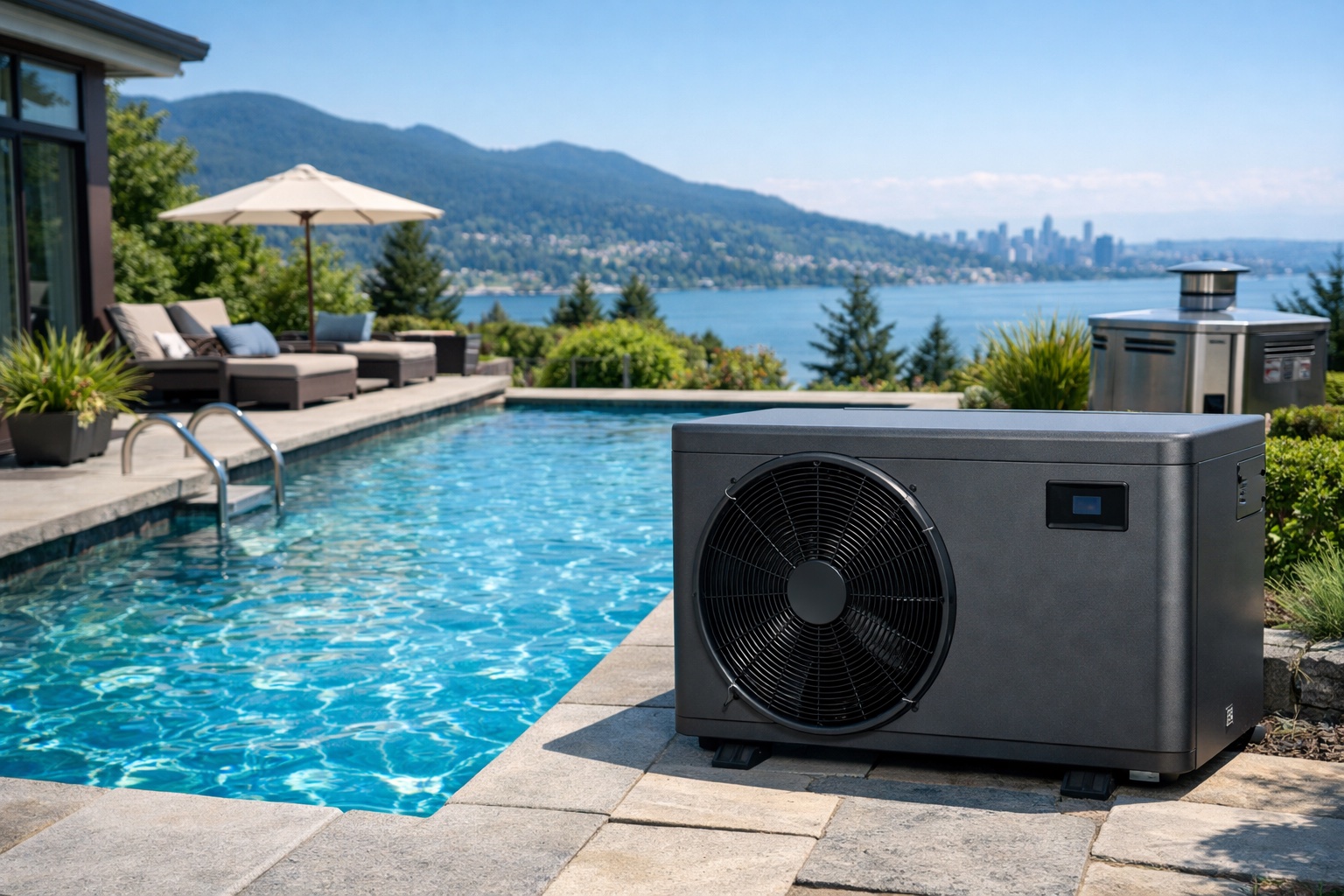
For homeowners building or renovating luxury properties with indoor swimming pools in Vancouver, West Vancouver, North Vancouver, or Whistler, the choice of heating system is one of the most consequential mechanical decisions in the project. An indoor pool operates year-round in a controlled environment, which fundamentally changes the heat pump vs gas calculus compared to outdoor pools. In this Eurohouse guide, we break down the science, the costs, and the practical installation realities of both systems, specifically for indoor pool rooms in British Columbia's coastal and alpine climates.
Why Indoor Pools Are a Different Equation
The critical difference between indoor and outdoor pool heating is the environment the heating equipment operates in. An outdoor heat pump draws warmth from ambient air, which in Vancouver might be 8 °C in March or 22 °C in July. Performance fluctuates with the seasons. But an indoor pool heat pump draws from the pool room itself, where air temperature is maintained at 27-30 °C year-round per industry standards. This means the heat pump always operates at or near its peak coefficient of performance (COP), regardless of whether it's a mild Vancouver winter or a -20 °C Whistler cold snap outside.
This single fact (that the source air is always warm) makes heat pumps dramatically more efficient for indoor pools than for outdoor ones. A gas heater's advantage (weather-independent output) is neutralized indoors, because the heat pump is also now weather-independent. The playing field shifts entirely to efficiency, operating cost, and integration with the dehumidification system that every indoor pool requires.
In an indoor pool room maintained at 28 °C, a heat pump operates at a COP of 5-6 year-round. This means for every 1 kWh of electricity consumed, the system delivers 5-6 kWh of heat to the pool water, an efficiency of 500-600% that gas cannot approach.
How Pool Heat Pumps Work in Indoor Applications
A pool heat pump uses a refrigeration cycle to extract thermal energy from the air and transfer it to pool water. In an indoor application, the unit is typically installed in the pool mechanical room and ducted to draw warm, humid air from the pool enclosure. As the heat pump extracts energy from this air, it simultaneously cools and dehumidifies it, addressing two critical indoor pool requirements in one system.
Dedicated indoor pool heat pumps (sometimes called dehumidifying heat pump pool heaters) are purpose-built for this dual role. They reclaim the latent heat from evaporation (which represents the single largest energy loss in any indoor pool), and redirect it back to the water. This heat recovery cycle is extraordinarily efficient, and it's why the most advanced indoor pool installations in West Vancouver and Whistler increasingly specify integrated heat pump dehumidification systems rather than separate gas heating and standalone dehumidifiers.
Residential models for indoor pools typically range from 60,000 to 140,000 BTU/hr output, with inverter-driven compressors that modulate capacity based on demand. For a typical residential indoor pool (300-500 sq ft of water surface), a unit in the 80,000-120,000 BTU/hr range is usually sufficient to maintain 28 °C water temperature with a properly insulated pool room and a quality pool cover used during off-hours.
How Gas Pool Heaters Work Indoors
Gas pool heaters burn natural gas or propane in a combustion chamber, heating water through a heat exchanger as it circulates from the pool. Gas units are rated by BTU/hr output: residential models commonly range from 150,000 to 400,000 BTU/hr, giving them raw heating power that exceeds most heat pumps. A gas heater can raise pool temperature by 1-3 °F per hour, making it effective for rapid heat-up scenarios.
However, installing a gas heater inside a mechanical room introduces significant complexity. Combustion requires oxygen, produces carbon dioxide, carbon monoxide, nitrogen oxides, and water vapour as exhaust. All of this must be safely managed in an enclosed space. BC's Gas Safety Regulation (administered by Technical Safety BC) and CSA B149.1 require sealed combustion air supply, Category III or IV stainless steel venting to the exterior, and specific clearances from combustible materials. The venting alone typically adds $1,500-$3,500 to the installation cost, and the mechanical room design must accommodate combustion air intake, usually two dedicated openings to the exterior, one high and one low.
Safety note: Gas heaters in enclosed indoor pool rooms require meticulous venting design. Combustion byproducts including carbon monoxide must be exhausted completely. This is a code-critical installation that requires a licensed gas fitter and inspection by Technical Safety BC. Improper installation can be lethal.
Gas heaters also operate at roughly 80-89% thermal efficiency (even high-efficiency condensing models top out around 95%), meaning 11-20% of the energy you pay for goes up the exhaust flue as waste heat. In an indoor pool context where the heat pump alternative runs at 500-600% effective efficiency, this gap is enormous.
BTU Output and Heating Performance
Gas heaters win on raw BTU output. A 400,000 BTU/hr gas unit will heat a cold pool faster than a 120,000 BTU/hr heat pump, there's no debating that. If you need to bring an indoor pool from 18 °C to 28 °C in a few hours (say, for a vacation home that sits unused between visits), gas delivers that burst of power.
But for the typical use case (maintaining a comfortable 28 °C in a pool that runs daily or near-daily), the heat pump's steady, efficient output is more than adequate. Indoor pools lose heat primarily through evaporation (which a cover mitigates dramatically) and through the building envelope (which proper insulation and vapour barriers control). Once at temperature, the heat pump's job is simply to replace these modest ongoing losses, which it does at a fraction of the energy cost of gas.
| Factor | Heat Pump (Indoor) | Gas Heater (Indoor) |
|---|---|---|
| Typical BTU/hr output | 60,000-140,000 | 150,000-400,000 |
| Efficiency | COP 5-6 (500-600%) | 80-95% thermal |
| Heat-up speed (cold start) | 0.5-1 °F/hr | 1-3 °F/hr |
| Dehumidification | Integrated, reclaims latent heat | None, separate system required |
| Indoor venting | Not required | Mandatory, sealed flue + combustion air |
| Emissions on-site | Zero | CO₂, NOx, CO (vented) |
| Equipment cost | $4,000-$12,000 | $2,000-$5,000 |
| Installation cost (indoor) | $2,000-$5,000 | $3,000-$7,500 (incl. venting) |
| Typical lifespan | 15-20 years | 8-12 years |
| Annual maintenance | Low, filter cleaning, refrigerant check | Moderate, burner tune-up, flue inspection |
Operating Cost: BC Hydro vs FortisBC for Indoor Pools
The economics of pool heating in British Columbia are shaped by two utilities: BC Hydro for electricity and FortisBC for natural gas. Both have specific rate structures that matter for this comparison.
Electricity (BC Hydro)
BC Hydro's residential rate uses a two-tier structure. The first 1,350 kWh per billing period costs approximately $0.1069/kWh, and additional usage is approximately $0.1609/kWh (2025 rates). For a home with an indoor pool (which will consume well above the first tier), the effective marginal rate is approximately $0.16/kWh for pool heating electricity. However, many luxury homes in West Vancouver and Whistler with indoor pools also have other high electrical loads (EV charging, electric heating, hot tub), so the blended rate often falls between $0.12 and $0.16/kWh. We'll use $0.14/kWh as a reasonable estimate.
BC's electricity is over 98% renewable (primarily hydroelectric), carries no carbon tax, and has historically stable pricing with modest annual increases of 2-4%.
Natural Gas (FortisBC)
FortisBC bills in gigajoules (GJ). As of 2025-2026, the all-in delivered cost of natural gas (including commodity, delivery charges, and storage) is approximately $9-$11/GJ for residential customers. Notably, as of April 1, 2025, BC eliminated the consumer carbon tax on residential natural gas, reducing bills by approximately 20-23%. This brings the effective cost to roughly $9/GJ, which equates to about $0.032/kWh of gas energy. However, at 85% heater efficiency, the effective cost per kWh of delivered heat is approximately $0.038/kWh.
Side-by-Side Operating Cost
Here's where the math gets compelling for heat pumps in indoor pool applications. Consider maintaining a 400 sq ft indoor pool at 28 °C year-round:
Heat pump at COP 5.5: To deliver 1 kWh of heat to the pool, the heat pump consumes 0.18 kWh of electricity. At $0.14/kWh, that's approximately $0.025 per kWh of heat delivered.
Gas heater at 85% efficiency: To deliver 1 kWh of heat, the gas heater consumes 1.18 kWh of gas energy. At $0.032/kWh gas cost, that's approximately $0.038 per kWh of heat delivered.
At current BC energy rates, an indoor pool heat pump delivers heat at roughly 35% lower cost per unit than a gas heater. Over a full year of operation, this translates to $800-$2,000 in annual savings depending on pool size and usage, savings that compound year after year.
For a typical luxury indoor pool consuming 80,000-120,000 kWh of heat annually (a reasonable estimate for a 400-500 sq ft pool maintained at 28 °C with a cover), the annual operating cost difference is significant:
Heat pump annual energy cost: ~$2,000-$3,000
Gas heater annual energy cost: ~$3,000-$4,500
Over the 15-year lifespan of a heat pump, this energy cost advantage alone can represent $15,000-$22,500 in total savings, more than offsetting the higher upfront equipment cost.
The Dehumidification Advantage
Every indoor pool requires active dehumidification. The warm water surface evaporates continuously, releasing moisture into the enclosed space. Without proper dehumidification, condensation destroys building materials: rot in wood framing, corrosion of steel, mould growth, and deterioration of finishes. This is not optional; it's a fundamental requirement of indoor pool design.
A standalone commercial dehumidifier for a residential indoor pool room costs $8,000-$20,000 and draws significant electricity. An integrated heat pump dehumidification system handles both pool heating and dehumidification in a single unit, recapturing the latent heat from condensation and returning it to the pool. This dual function eliminates the need for a separate dehumidifier, reduces total equipment cost, lowers energy consumption, and simplifies the mechanical room layout.
If you're heating with gas, you still need a separate dehumidification system, adding both equipment cost and ongoing electrical consumption. When you factor this in, the total system cost of "gas heater + dehumidifier" often exceeds "integrated heat pump dehumidifier" despite the heat pump's higher individual unit price. This is a detail that many homeowners and even some contractors overlook when comparing sticker prices.
Indoor Pool Construction in Whistler: A Special Case
Whistler presents unique conditions for indoor pool heating. Exterior temperatures regularly drop below -15 °C in winter, which would devastate an outdoor heat pump's performance. But for an indoor pool, the heat pump's source air is the pool room, maintained at 28-30 °C regardless of outside conditions. The heat pump doesn't know or care that it's -20 °C in Whistler; it's operating in a warm, humid room, exactly the conditions where its COP is highest.
What Whistler does demand is superior building envelope performance. The pool room needs excellent insulation (minimum R-30 walls, R-50 ceiling for alpine conditions), a continuous vapour barrier on the warm side, high-performance glazing if windows are present (triple-glazed minimum), and careful attention to thermal bridging at structural connections. Eurohouse Construction's experience with complex residential builds in both coastal and alpine BC means we understand the structural, waterproofing, and insulation requirements that make an indoor pool room in Whistler viable and durable over decades.
Natural gas availability in Whistler varies by location. Some areas are served by FortisBC, but many resort properties rely on propane, which is substantially more expensive (often $0.06-$0.08/kWh of energy, nearly double natural gas). For propane-dependent properties, the heat pump's cost advantage over gas becomes even more pronounced.
Installation Considerations for Indoor Mechanical Rooms
The mechanical room for an indoor pool is one of the most technically demanding spaces in residential construction. It houses the pool pump, filter, heater, chemical treatment system, and (if a heat pump dehumidifier is used), the combined heating/dehumidification unit with ducting. Here are the key differences in installation requirements:
Heat Pump Installation (Indoor)
The heat pump dehumidifier is ducted to draw warm, humid air from the pool room and return conditioned (dehumidified) air back. Supply and return ductwork must be properly sized to handle the air volume: typically 1,000-3,000 CFM for residential pools. The unit requires a 240V electrical circuit (typically 30-60 amps depending on BTU capacity), a condensate drain, and pool water plumbing connections. No gas piping, no combustion air, no exhaust flue. The mechanical room can be smaller and simpler because there are fewer safety setback requirements.
Gas Heater Installation (Indoor)
A gas heater requires a gas supply line sized for the BTU rating (often 1" or larger for high-output units), a dedicated sealed exhaust flue to the exterior, combustion air intake (two openings to outside air, properly sized per code), a 120V or 240V electrical connection for controls, pool water plumbing, and code-mandated clearances from combustible materials. The exhaust flue must be Category III or IV stainless steel for indoor installations, standard B-vent is not permitted for pool heater applications in most jurisdictions. The combustion air requirement means the mechanical room effectively has two permanent openings to the outdoors, which can introduce cold air and increase the heating load of the room itself in winter.
When you also add a separate dehumidification unit (required with gas heating), the mechanical room needs additional floor space, additional ductwork, additional electrical circuits, and additional condensate drainage. The cumulative installation complexity and cost often makes gas the more expensive option to install indoors, despite the lower equipment price for the heater itself.
Lifespan, Maintenance, and Total Cost of Ownership
Heat pump pool dehumidifiers in indoor applications typically last 15-20 years. They operate in a clean, controlled, warm environment with no exposure to weather, which extends component life compared to outdoor installations. Maintenance is straightforward: periodic coil cleaning, refrigerant level checks, filter changes, and compressor inspection. Most quality units carry 5-10 year compressor warranties.
Gas heaters in indoor pool environments typically last 8-12 years. The combination of high operating temperatures, condensation in the heat exchanger (especially in the humid air near a pool), and thermal cycling accelerates wear. Annual maintenance is essential: burner inspection, heat exchanger check for corrosion or scale, flue integrity verification, gas leak testing, and safety control testing. Neglecting maintenance on an indoor gas heater is a safety risk, a compromised flue in an enclosed space can allow combustion gases including carbon monoxide into the building.
Total Cost of Ownership: 15-Year Comparison (Typical 400 sq ft Indoor Pool)
- Heat pump system: $6,000-$17,000 equipment + installation, $2,000-$3,000/year energy = $36,000-$62,000 over 15 years
- Gas + dehumidifier system: $10,000-$22,000 equipment + installation (heater + dehumidifier), $3,500-$5,500/year energy (gas + dehumidifier electricity), one heater replacement at year 10 (~$4,000) = $66,500-$109,500 over 15 years
- The integrated heat pump system typically saves $20,000-$50,000 over 15 years when all costs are considered
Environmental Considerations
BC Hydro's grid is over 98% renewable, predominantly hydroelectric. Running an electric heat pump for pool heating in BC produces virtually zero greenhouse gas emissions. A gas heater burning natural gas emits approximately 50 kg of CO₂ per GJ consumed. For a pool consuming 100 GJ of gas per year, that's 5 tonnes of CO₂ annually, equivalent to driving a car approximately 20,000 km.
While BC's residential carbon tax was removed from consumer bills in April 2025, the broader regulatory trend in Canada continues toward electrification. New building codes increasingly favour heat pump systems, and future policy changes could re-introduce carbon pricing or restrict natural gas in new construction. Choosing a heat pump today positions your property on the right side of these trends, and adds a marketable sustainability feature to a luxury home.
Which System Should You Choose?
Choose a heat pump if…
You're building or renovating an indoor pool that will be used regularly (weekly or more). You want the lowest operating cost, integrated dehumidification, zero combustion exhaust in your home, a 15-20 year equipment life, and alignment with BC's clean energy grid. This covers the vast majority of indoor pool installations in Vancouver, West Vancouver, North Vancouver, and Whistler.
Choose gas if…
You have a vacation property where the pool sits cold for weeks at a time and you need rapid heat-up on arrival. You already have natural gas service and a mechanical room designed for combustion equipment. Or you're supplementing a heat pump system with a gas booster for fast recovery, a hybrid approach that some luxury properties employ.
Consider a hybrid system if…
You want the efficiency of a heat pump for daily maintenance heating and the raw BTU power of gas for occasional fast recovery. This is increasingly common in high-end Whistler properties where the pool may be unused for days between occupancy periods, then needs to be at temperature quickly for arriving guests.
Eurohouse Recommendation for Indoor Pools in Greater Vancouver
- For daily-use indoor pools: integrated heat pump dehumidifier: lowest total cost, simplest installation, zero emissions
- For vacation or intermittent-use indoor pools: heat pump primary with optional gas booster for rapid recovery
- Always pair with a quality automatic pool cover, reduces heat loss by 50-70% and cuts energy costs dramatically regardless of heating system
- Size the system based on pool surface area, desired temperature, and room insulation, undersizing creates comfort problems and oversizing wastes capital
Eurohouse Construction: Indoor Pool Mechanical Expertise
Building an indoor pool is one of the most complex residential construction projects a homeowner can undertake. It requires structural engineering for the pool shell and the building that houses it, waterproofing and vapour barrier systems to protect the building envelope, mechanical design for heating, dehumidification, and ventilation, electrical work for the pool equipment, lighting, and safety systems, plumbing for pool circulation, chemical treatment, and drainage, and finishing for the pool room interior including materials that withstand high humidity and chlorine exposure.
Eurohouse Construction has delivered complex residential projects across West Vancouver, North Vancouver, Vancouver, and Whistler since 2009, including luxury homes with sophisticated mechanical systems. As a licensed general contractor with deep experience in coordinating structural, mechanical, electrical, and finishing trades, we're equipped to manage the full scope of an indoor pool construction project from design coordination through commissioning.
Whether you're planning a new indoor pool as part of a custom home build, adding one to an existing property, or upgrading the mechanical systems on an aging indoor pool installation, Eurohouse can help you evaluate the right heating and dehumidification approach for your specific situation, climate zone, and usage pattern.